
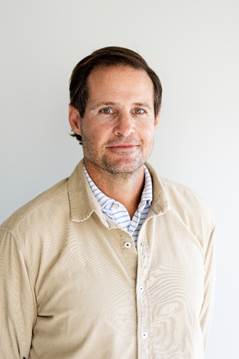
About Trevor Colhoun
Trevor Colhoun is the CEO and co-founder of TPN.health, the nation’s digital home for behavioral health providers. In just six years, TPN.health has grown to over 160,000 clinicians across all 50 states, with thousands joining every month. The platform has powered over 450,000 continuing education hours and more than 300,000 events, making it the most trusted space for providers to connect, learn, and advance their professional growth. Under Trevor’s leadership, TPN.health has expanded into a next-generation ecosystem that unites providers, payers, and patients. Trevor’s background spans private equity, organizational leadership, and philanthropy, where he has served on boards including The Millbrook School in New York and SBP in New Orleans. Today, he is leading TPN.health and the behavioral health industry toward a provider-first future.

About TPN.health
TPN.health is the operating system for behavioral health. Built by clinicians for clinicians, the platform serves over 150,000 verified providers nationwide with free premium continuing education, professional networking, referral pathways and the tools they need to practice their way. For health plans and payers, TPN.health delivers accurate provider networks and expert, human-led care navigation that improves access and outcomes. Together, this infrastructure enables the shift to value-based behavioral health care. Learn more at TPN.health.
Medical Travel & Digital Health News (MTDHN): Please tell our readers how you got involved in the TPN.health venture?
Trevor Colhoun (TC): I grew up as a dyslexic kid and went through a lot of early traumas, especially in the 1980s when people didn’t understand the condition.
People with dyslexia experience identity crises and low self-esteem, in terms of intellect and capabilities. They really have to fight and get through all these issues. But as a result, you create a tremendous amount of empathy and understanding for other people who struggle with all kinds of different challenges.
I think that was the basis and a really important piece of my life that allowed me to build a company like TPN.
On the career and professional side, I had a front seat in watching the digitization of the financial markets. I started off at Bear Stearns where we were running tickets into the cage to make a trade. It was the late 90s – not that long ago. Fast forward to today’s financial world and it’s completely digital where everything happens in fractions of seconds.
Digitization was made possible because of the digital infrastructure of fiber optics and data connectivity. The financial institutional markets had a leg up on everybody because they had a tremendous amount of data that was very ubiquitous and readily available. Building a financial marketplace was easier than behavioral health because there was access to data.
MTDHN: How did you transition to behavioral health?
TC: The challenge was to create data connectivity and the user experience (UX) infrastructure of a marketplace to actually digest the analytics for behavioral health.
The final piece that allowed me to start TPN was my own journey through behavioral health and the issues associated with dyslexia. Then there occurred some really acute behavioral health events with family members and we had to walk through some high-acuity traumatic situations.
This allowed me to see the failures of behavioral health care delivery: how analog, bifurcated and siloed it was in terms of engaging patients with clinicians. I think that was the biggest thing – and is still true today.
This sparked my professional interest and drove my intent to fix the process. It allowed me to guide my loved ones, help them with a choice of facilities and treatments and impact their outcomes.
MTDHN: How did you actually start the business?
TC: The experiences I just related happened in 2017-2018, a time period when my passion grew steadily for improving the behavioral health industry and infrastructure. My empathy for patients and understanding of humanity quickly developed and an idea started to form.
In 2019, there was an existing TPN company, but it was struggling. We decided to restructure its operations and change its direction. Our goal was to really think about and create a trusted provider network to answer the problems that persisted in the marketplace.
Basically, if there’s no marketplace, there’s no ability to demonstrate value.
Everything that we deal with in the US depends upon the exchange of dollars in a marketplace supported by transparency and an understanding of value – from buying grocery store products to accessing medical services. If I go for knee replacement, there is a cost, including the recovery time and how long I must be incapacitated.
It all comes down to how much money I am going to spend to get the care I need and the outcome I want? I understand that there are certain sureties for a good physical outcome, but none of that exists in behavioral health.
MTDHN: How did you tackle the challenges?
TC: Right from the beginning and still today, we want to create a value proposition for behavioral health: actually demonstrate the value of the services, determine who the patient needs to see and how long treatment will be required. If I can’t answer these questions, I don’t know cost.
If I don’t know cost, I’m not starting treatment. The numbers tell us this information. If there are 75 million people in the US that need to enter in behavioral health treatment annually, but only 15-17 million or 20% do so, that’s ridiculous.
It’s not because of stigma and it’s not because of access. It’s because nobody has been able to really demonstrate the value proposition. As a result, payers haven’t been able to build a structure around an institutional process of a marketplace to pay providers and understand what results and outcomes can be.
Providers haven’t been able to demonstrate it. And if payers can’t really articulate it properly, they don’t have a correct process to bring providers into a system. This has created an untenable process.
So, we realized that the most important person in this entire equation is the individual provider because 70% of the service that’s provided for behavioral health is really a “single shingle.” It’s a one or two-person person shop.
We recognized that if we brought these folks into a digital environment, then through their engagement you would have connectivity to them: who do they want to serve, are they available, are they licensed? From this engagement and connectivity, we generated valuable data to start informing the foundation of a marketplace.
The objective is to have accurate data. And then you can make a marketplace.
MTDHN: What specific steps did you take?
TC: During the first five years of this company, we figured out how to get providers en masse into TPN, visit our model often and remain involved.
The simple equation is to provide them with utility that makes their life better and take away financial friction. For free, we give them a high-value proposition. And that’s been our secret sauce to building this network of providers and their associated data.
Now we have 145,000 providers with 80+ percent accuracy and understanding of who they are and who they serve. With that, we are building a marketplace, in essence, an exchange.
We realized that if we have these providers, whether they’re individual or group practices or facilities, we can then do many things because now we have data. And with that data, we can credential each clinician.
We can contract them on our own paper, access all the information and share the data with our at-risk payer partners — employers, TPAs, health plans, unions and other stakeholders.
MTDHN: Please describe your business model.
TC: We knew that we could build a dollar transaction model, including claims repricing. If you handle the claim, then you can really drive the important features of the market.
All these steps were incremental, but the last thing that we did was consequential: create a care navigation process to complete the value proposition.
Because if you have the data, the network and the connectivity — which we have — this becomes a real market solution. You have a professional on the front end, think a primary care provider on the physical health side, and a care navigator who’s a licensed social worker or licensed counselor that can diagnose right away in the beginning of the care journey as a patient enters into behavioral health.
The navigator calculates a person’s personality score so we can perform a care alliance match to our provider network. The matching process is deeply steeped in terms of the size and scope of the data, enabling the creation of a positive outcome.
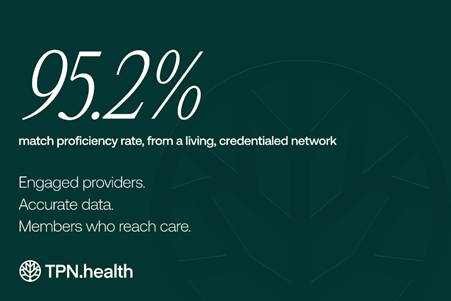
The net results of what we’re seeing is 95.2% match proficiency with only a 21% dropout. Nobody has achieved such results.
What the number means is this: the individual goes to three or four appointments with the same clinician. So, 79% of our people do that. With other services, individuals see one provider and drop out. In existing behavioral health solutions, there is no value and there’s no continuing care that results in some level of recovery.
MTDHN: Can you provide some details about the types of providers that are included in the TPN network?
TC: We include all types of providers and treatment options for all levels of acuity:
Medical and Prescribing Providers
- Psychiatrists (MD or DO): Medical doctors who specialize in mental health, diagnose disorders, and prescribe medications.
- Psychiatric-Mental Health Nurse Practitioners (PMHNP): Advanced practice registered nurses who can assess patients and prescribe psychiatric medications.
Doctoral-Level Clinicians
- Psychologists (PhD or PsyD): Professionals who hold doctoral degrees, conduct psychological testing, provide psychotherapy, and diagnose mental health conditions without prescribing medication (in most states).
- Neuropsychologists: Specialists focused specifically on how complex relationships between the brain, nervous system, and behavior affect mental health and functioning.
Master’s-Level and Specialized Clinicians
- Licensed Clinical Social Workers (LCSW / LICSW): Clinicians with a master’s degree in social work trained in psychotherapy and connecting patients with community or social support systems.
- Licensed Mental Health Counselors (LMHC / LPC): Therapists with a master’s degree who provide individual, family, and group talk therapy.
- Licensed Marriage and Family Therapists (LMFT): Specialists trained to evaluate and treat psychological distress within the context of family systems and couples.
- Substance Use / Addiction Counselors: Certified professionals who focus strictly on treating alcohol and drug dependency.
- Board Certified Behavior Analysts (BCBA): Specialists with master’s degrees who use applied behavior analysis primarily for autism and developmental conditions.
Treatment Options
- Lower acuity, monthly therapy sessions
- PHP (Partial Hospitalization Program)
- IOP (Intensive Outpatient Programs) that are structured, day-treatment options that sit between traditional weekly therapy and 24/7 inpatient hospitalization. Patients return home each evening instead of staying overnight.
- Detox
- Residential
MTDHN: What about virtual care?
TC: The ubiquity of virtual care is evident, but our model is not simply virtual.
For other behavioral health companies, virtual care simply solves their problem: a lack of provider networks. So, they create virtual, which is one-size-fits-all.
The virtual solutions that we see are a finger in the dam the size of Canada. Virtual is great as a solution that was born out of COVID and grew significantly. And a lot of companies popped up to offer virtual care because it was easier for them to stand-up a solution that also solved another problem: lack of provider networks.
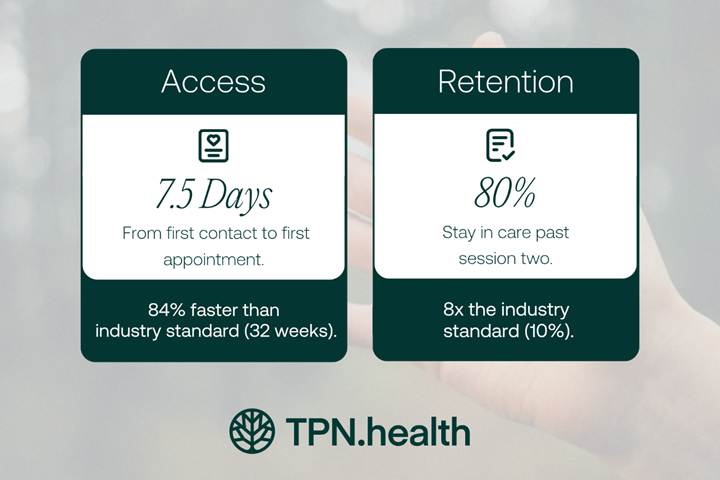
You don’t need a massive provider network to do virtual and still have a big reach. But experience shows there is a large dropout rate, as high as 80-90%. This means that individuals are only going to one session and then dropping out.
In comparison, look at physical health. If you have a heart condition, here’s a doctor – but what kind of doctor is it? A cardiologist, to diagnose and treat standard heart issues like high blood pressure and chest pain. Or an interventional cardiologist, an electrophysiologist, a heart failure specialist or other subspecialty? Because that matters.
That’s why we’ve been very purposeful about building the supply side of behavioral health clinicians before we go to the demand side with any offering. Now we have the capacity and can navigate care for millions and millions of lives. We can handle any size population and actually find a quality match — virtual or in person.
MTDHN: What about outcomes?
TC: We are starting to see positive outcomes, explicit value for the dollars that are being dedicated to behavioral health — starting from the beginning with a diagnosis, personality scoring and then taking that data to implement a Care Alliance.
Here’s what Care Alliance means. It’s been clinically tested for 40 years and rests upon the patient’s trust in the clinician, the clinician’s experience and understanding of the individual’s life experience and family origin history. The individual must feel comfortable and confident in their clinician…a real connection.
This might seem like common sense but it’s a huge piece in determining outcomes and the value of the therapy. Starting off with a proper care alliance match can jump-start outcome rates at over 60%.
MTDHN: So, I am a TPA or an employer reading this article and I’m thinking to myself, “Wow, sounds great.” What is your business model? What does that mean from a financial perspective to the payer?
TC: We’re not a point-end solution. We’re an end-to-end, full encompassing solution.
When someone works with us, they’re getting a full behavioral health solution with full data and results and tracking of the lives that come through our model. Plan members are not getting a directory because we don’t have one.
In fact, the world’s most accurate directory is failing, simply driving up costs. Patients just go hog wild and say, “I’m going to see this therapist.” They get a text number and never connect or connect with a clinician that is inappropriate to their condition.
With the TPN model, the first point of contact is a care navigator that holds their hand, diagnoses and matches them to the right clinician. Our pricing model is not a PEPM or a PMPM. We don’t set up fees — we perform a full utilization model.
All our payer relationships get one biller – that’s TPN. We handle all the providers, we handle all the credentialing, we handle all the adjudication.
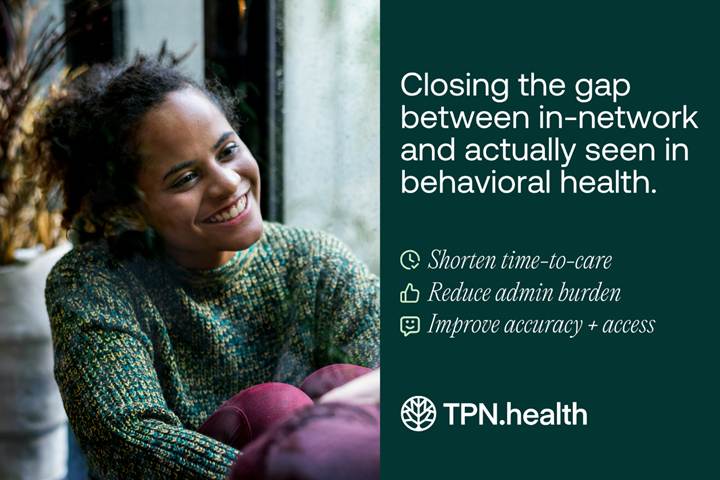
Payers can lower the amount of CPR codes per life, year-over-year, because we’re able to shrink the timeframe in terms of getting to the right appointment first. Payers will also lower their costs because there’s access to care in terms of talking to a care navigator in 7 minutes vs. going to take them out of the emergency room.
This approach is also going to take them out of the primary care office and get them the appropriate medicines they need in the appropriate amount of time.
Plus, this enables outcomes tracking and knowing exactly what is going on. Payers can verify these appointments are happening and know that a specific member saw a specific clinician and what was involved. And we could go further and actually continue to track outcomes for months, if that’s important to the plan.
MTDHN: Theoretically, you could outsource your behavioral health.
TC: 100%.
The TPAs we work with not only outsource it, but then they discover the benefit of including all other behavioral claims.
They direct those providers that are sending them claims to send them directly to TPN and come through our process. This creates a better relationship between the at-risk entity and the member life. Now the member is either paying their co-pay or no co-pay because they’re paying their insurance. They’re not getting a super bill.
Our provider network is massive, ever growing and doubling every year. This is very comforting to payers, and our member satisfaction scores are off the charts. We advocate for each member life.
Think of a mother with a young child that needs psych testing because they might be ADHD or other. It is very difficult to find a clinician and at what cost. It’s expensive.
We handle these types of challenges all day long. This presents high value to the employee – the mother gets peace of mind, is back in productivity and relieved that her child is actually getting the care that they need and deserve.
MTDHN: How does this interact with the payer’s electronic health record for each member? Is there integration?
TC: Yes. All the data is there to conduct integrative care. We can work with integrative care companies that aggregate that data.
MTDHN: Let’s just drill down a little bit into the behavioral health conditions. People are familiar with PTSD, substance use, depression and anxiety. What about autism spectrum disorder (ASD)?
TC: Yes to all. Recently, we navigated several cases of ASD and are very much breaking into that market. We were able to lower costs for a TPA plan and get great results. It was two 60-day stays and we lowered the cost by 20%.
We actually have a senior executive on our staff who works in this space. The challenges are ongoing as the child ages and the intensity of treatment is particularly valuable as they become adults.
MTDHN: Is the cost of care a concern to employers?
TC: People may complain about how expensive it is to provide this care, but it’s very taxing on the employer to cover the cost of behavioral health care.
It’s a big, large problem that really hasn’t been solved. It’s really killing the cost margin for a lot of providers. But it doesn’t stop there in terms of the American with Disabilities Act.
You’re talking about so many issues — isolation and loneliness, digital addiction, eating disorders and pain management. We deal with a lot of groups that have presented these problems. Chronic pain is really connected to old, stored trauma and many people have accessed emotional behavioral health modalities to actually eliminate their chronic pain.
MTDHN: Do you have any designs on taking this to an international marketplace?
TC: We do, but we’re not doing anything now. There’s so much to do right now in the US.